
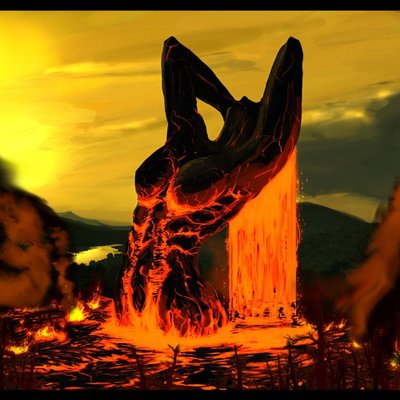
GODDESS PELE LIVES
The Dance of Earth and Fire at Hawai’i Volcanoes National Park
by Jonathan Ansley Ward
Prayer to Mother Pele
I’ve melted into Your magic once again
Howled at the hula moon
Danced in a warm rain
My soul has bowed at your heiaus
My Mother Pele
And I heard your whispers
With the trade winds
With the gentle rains
And I answered
Mother, possess our hearts
Surround us with Your Love
“How hot is the sun?” I wondered as a friend and I were trekking across the Kīlauea Iki Crater in Hawai’i Volcanoes National Park in 1991. We took a break and I was laughing to see my friend sitting on a rock with steam seemingly coming out from under him. “How hot is the sun?” Could it be hotter than molten lava at 2100-degrees? And how far below us was the fiery lava? Could it spout up and barbecue us at any moment? These questions certainly made our hike more exciting.
But seriously, when did I begin a quest to understand the Hawaiian Goddess Pele? Perhaps it was on my first trip to Hawai’i Volcanoes National Park. At that time the Crater Rim Road was completely open and we parked very near the traditional home of Pele, the HalemaUma’U Crater, which is contained within the much larger Kīlauea Caldera. Because of eruptions starting in 2018 within HalemaUma‘U, that half of the crater-encircling road is now closed.
On my first visit I recall a sulphury smell, the steam, offerings of flowers and leis, and broken gin bottles on the crater rim. On another trip I witnessed hula dancers accompanied by drumming, all chanting to and dancing for the Goddess Pele. Their robes of red and white, multicolored and green leis and head-dresses, the chanting and dance in such a remote place of fiery creation was magical, and I was enchanted.
The Tahitian discoverers brought their religion to Hawaii between 500 and 1300 AD. They recognized four main spirits and 400 lesser ones, all descended from the Earth Mother and the Sky Father. Goddess Pele is one of the 400 spirits. It is said that she journeyed from Tahiti via canoe. She attempted to use her fire to create land en route but was foiled by her sister Nāmaka, the sea goddess, who followed in hot pursuit. In the end the two sisters fought at Kīlauea over a man—a sorcerer! Pele was killed, but her spirit lives on in the HalemaUma’U Crater. She’s affectionally called Tūtū or Auntie Pele by Hawaiians — “The Creator of the Hawaiian Islands” and “The Goddess of Fire and Volcanoes.”
Destructively and constructively speaking, she’s also known as “The Earth-Eating Woman” and “She That Shapes the Sacred Lands.” Her home is one of the most active volcanoes on earth. An early record, literally “written in stone,” memorializes an eruption in 1790 that killed several warriors opposed to King Kamehameha; their footprints are believed to be preserved in lava at the national park.
Since 1800 there have been sixty-one separate eruptions, including one in 1840 from a twenty-two-mile long fissure that lasted for twenty-six days. In 1983 the Pu’u Ōō volcanic cone erupted and continued for another 35 years, flowing down the slopes of Kīlauea destroying the villages of Kalapana and Kaimū. Years later Pele’s lava nearly reached the town of Pahoa, stopping just a few hundred yards short.
In 2018 at Leilani Estates, Puna District, molten lava erupted from two dozen fissures. Two thousand people were evacuated. Lava fountains reached over 300 feet high. Over the next several months lava flowed to the sea, covering 13.7 square miles, destroying 716 structures, filling Green Lake, and destroying the Kapoho tide pools and the Ahalanui Park hot pools. Lava filling Kapoho Bay formed 375 acres of new land. Some spared homes and lands became “lava-locked” along the lava flow route, until months later when bulldozers could reach them. Presently eruptions are contained within the HalemaUma‘U crater. In the evening the golden fiery glow may be viewed from the UēKahuna Overlook.
Because some Hawaiians consider the lava comes from the goddess, they believe it should not be impeded. Others think that steps should be taken to guide the flow away from populated areas. When General George S. Patton was stationed on Oahu in 1935, he sent military planes to bomb a lava flow headed for the town of Hilo; strangely, the gambit seemed to work!
Today Goddess Pele’s home, Hawai’i Volcanoes National Park, contains two volcanoes—Mauna Loa and Kīlauea—as well as a rainforest, a bird sanctuary called Kīpuka Puaulu, and a rocky coastline dotted with sea arches. The park was established in 1916 after a push by local businessmen – at one point the Hawaiian Territory hosted fifty members of congress at the site. Lava fields, eruptions, hiking trails, and the drive down the Chain of Craters Road all make the park an awe-inspiring adventure in untamed nature.
And finally back to our hike: We had started at the Volcano House Lodge, going down a fern-lined path into the Kīlauea Crater, then crossed a low ridge and into the Kīlauea Iki Crater (a side crater). The trail took us about a mile or so straight across a jumbled, hardened crater floor, broken here and there by red-berry-covered ʻŌhelo plants and steam vents. We then followed switchbacks up to the rim at the Thurston Lava Tube loop trail. From there, we trekked along the rim back to the lodge. Between the moonscape of lava in the crater and lush ferns and flowers along the rim, it’s a beautiful and unusual five-mile loop.
It was while we were in the Kīlauea Iki Crater, with heat waves and steam wafting around us, that I came to appreciate a deeper meaning of Goddess Pele. By whatever name one wishes to call her, or in whatever form she is seen, she is the mother of creation. Her spirit is in the earth and shapes the earth, and we manifest her spirit when we ourselves are creative.
Later I discovered that the sun is indeed hotter than molten lava – 27 million degrees Fahrenheit – at its core.
LAVA-LOCKED
My heart is lava-locked
In the fields of Kalapana
Madam Pele’s hot kiss
Is in my soul tonight
The starry skies of Ka Lae
The green sands and black
Oh the Temple of Wood Valley
They are calling me back
My heart is lava-locked
From Leilani to Kapoho
Madam Pele’s firey love
Is in my soul this night
The starry skies of Mauna Kea
Mauna Loa’s forests of rain
The Daughter of Creation
Is calling me back again
SIDEWAYS IN KALALAU by Jonathan Ansley Ward
It was twilight; my legs had been swept out from under me by a flash flood gushing down the Hanakāpīai Stream on the Nā Pali Coast of Kauai. I held tight to a rope extended across the torrent. From my sideways position, I could easily be sucked downstream and out to sea. At that point, the crowning achievement of that day would be to stay alive.

The day started wonderfully enough; I was camping with two friends at Polihale Beach. Polihale is the end of the road, southeast on Kauai, just past Barking Sands Beach and the Pacific Missile Range. It’s a paradise-like place to camp, picnic, swim in summer, and watch sunsets over the Hawaiian-only island of Ni’ihua. The couple of days there I spent immersed in the warm ocean or enjoying friendly people and great food. After breakfast, one friend was kind enough to drive me counterclockwise around Kauai to the Kalalau Trailhead at Ke’e Beach. I intended to hike the trail alone and meet up with my friends three days later.
The Kalalau Trail is a bucketlist hike for many lovers of Hawaii and backpacking/camping enthusiasts. The trail is 11-miles long and ends in Kalalau Valley, the Eden of camping in Hawaii. Even though mostly at about sea-level, hiking in the tropics can be strenuous. Perhaps it’s trekking in humidity through jungle that makes it so. However, the views, the smell of over-ripe guavas, something or the sum of everything make this experience what it is. Parts of the trail are 2,000-years old, but the trail as it is today was built in the 1850’s and then rebuilt in the 1930’s. The Nā Pali Coast, along which the trail ambles, is dotted with waterfalls and green cathedral-like peaks, all bordered by turquoise ocean.
After breakfast and the 90-minute ride, it was a semi-late start. I quickly climbed up the rocky path, enjoying the views ahead where the green cliffs melted into a crashing blue sea; now and then I took time to look back toward Ke’e Beach and enjoy the views behind. I was happy and inspired. I crossed the Hanakāpīai Stream about noon, and happily shared a peanut butter and guava jam sandwich with some wild cats along that shore. From there the trail does get smoother as it climbs out of the first valley. However, I grew concerned because to the northwest a wall of clouds was forming, and the wind was picking up, smelling of rain.
After five-miles, I arrived at a dilapidated trail shelter in Hanakoa Valley and met a guy in a camo-colored rain poncho. Because of the changing weather, he frantically implored me to speed up to make it across the most dangerous part of the trail, Crawlers Ledge, and on to the safety of Kalalua Valley. The coming storm would render the trail impassable. He trotted off, and I was left to chart my own course. It was 3:00 in the afternoon, but the sky was darkening. I quickly decided to pitch my tent and ride out the storm there. Within 20 minutes, however, the rain arrived sideways, riding on a howling wind. My tent buckled so hard that I quickly reassessed my situation. I decided to retreat to the trailhead. I did not want to get stranded, thinking that if I was to get back across the Hanakāpīai Stream it needed be sooner rather than later.
I scrambled out of my tent and was instantly soaked with warm, tropical rain. I dragged my tent and gear into the 3-walled trail shelter. I quickly packed up, but before I left I scanned the graffiti-covered wall of the shelter and read, “Everything is of your own making, of your own karma.” Soaked to the bone and not appreciating the message, I turned to the opposite wall and read, “Know what I mean, Vern?” I headed out into the wind, rain and fading daylight, but I had a smile on my face.
It was a dangerous hike, sometimes walking and others crawling and sliding. After three miles I reached again Hanakāpīai Stream. Although the water was moving fast, it wasn’t deep so I thought I could get across easily. Thankfully, someone had tied a rope across the span which I latched onto as I entered the powerful water. It was mid-stream when I lost my footing and was dangling sideways in the churning flow. Slowly and carefully, I was able to get a foothold and pull myself to safety. I was shaken a bit and sat on the bank for a few minutes, looking downstream at the vast expanse where the stream collided with Pacific waves. Thankfully, the storm abated for the next few hours.
The last two miles to the trailhead were spent in twilight and introspection – grateful to be alive, but also I thought deeply about my loving wife, my good friends – hey! I had people who cared about me and blessings in my life. Before that day I took it all somewhat for granted.
I arrived at Hāéna Campground about about 8:00. People were gathered under a large awning, over picnic tables in the center of the field. Some immediately came and greeted me, grabbed my gear and helped me set up my tent. They invited me over to their party, very merry for several reasons, both outer and inner, despite bad weather swirling around us. I was alive and enjoying every moment. Later, as I sat at the opening of my tent looking out onto ocean, moon and stars, I felt thankful for my life – for adventures, and for family and for friends – those long-timers and those I’d met just that evening.

INDIA TRAVEL JOURNAL
India Travel Journal 1
Mumbai – Bombay
India: Land of Saints and Saint of Lands.
Sitting in the Oberoi Towers hotel lobby awaiting others for breakfast at the restaurant: “Frangipai: Nutty, Bitter, Smooth, Complex.” I wonder which category I fall within?
Yesterday, my first this life in India, was definitely all of the above. After breakfast, we walked Arabian Sea front; beautiful young ladies from Rajasthan sold us colorful peacock fans and pocketbooks. A sage wearing saffron waved at us and nearly knocked us over with radiating bliss. India is different. After lunch, we went on a shopping adventure via taxi —we experienced several miracles of near misses during the demolition derby through the city.
The highlight of the day was meeting with YSS (Yoga Satsanga Society—Self-Realization Fellowship in America) member, Nitan Samarth, who took me to the centuries old Bubble-Nath Shiva Temple where we made offerings before the Shrine. Next he took me by Victoria Train Station, the Gate of India, and the hotel where our gurudeva Paramahansa Yogananda may have stayed here in 1936 on his return to America. It was a magical day filled with the bustle and peace which marks my pilgrimage to India thus far.
Today plans are made to see Elephanta Island and perhaps again see my new-old friend Nitan. Oh yes! We had a coconut milk along with twilight streets of holy Mumbai, where children and saints bless the waterfront in the tranquil light.
India Travel Journal 2
Delhi, India in route to YSS Ranchi Ashram
A most interesting day yesterday: Delightful boat trip to Elephanta Island in Mumbai Bay. We embarked at the Gate of India – built to commemorate some English king coming – but more importantly my Guru was here. We saw Shiva Temple-caves carved from solid rock centuries ago. Unbelievable! The two stone lingams were blessed with the holy vibrations from the centuries of devotion. I tripped and took a fall in the sanctum as I knelt, and I felt as though I was thus being saved from a future tragedy by the Lord – working out that karma in a smaller way. Later, I had an Indian veggie burger for lunch – the catsup was like rocket fuel (thus saved from a future rocket accident).
In the evening we went to a gorgeous Jain Temple, a lovely park, the home where Gandhi lived when visiting, which as been turned into a museum.
Mumbai is 16-million souls confined on three islands: hustle, bustle, dogs, cows, Bollywood — it’s hard to describe without actually experiencing it firsthand. I am looking forward to seeing Ranchi Ashram; a site hallowed by Paramahansa Yogananda where he founded a school in 1917.
India Travel Journal 3
Ranchi, India
On a Saturday we arrived in Ranchi via Delhi and Patna on India Air. The ashram is an abode of peace and beauty. Had a lovely meditation and dinner last night in this paradise.
Got up very early in the morning to meditate. Had our small group exercises and meditation later at the Smriti Mandir where Paramahansa Yogananda had his vision of Americans before journeying to Boston in 1920; written there are some of Yogananda’s last words “Only Love Can Take My Place.” In the early dawn a devotee was doing Shiva Puja in a little shrine mid-ashram. There’s even a dairy.
Later at Sunday service a YSS Swami said, “Gurudeva (Yogananda) is so proud of you; so proud of those who have come to know him but have come after he has left his body, especially those who serve his organization.” I really needed to hear that because in the mandir about two hours before I had been telling Yogananda how unworthy I was, that I couldn’t do anything right. I was so touched within to hear the Swami’s words.
A wondrous feature of the Indian ashrams is aarati (offering of light) performed before mediations and services by reverently circling a torch in front of the altar. Also, bhajans are sung for half an hour after Sunday services, and then they serve proshad (blessed food) on your way out. The devotees are definitely on the bhakti (devotional) path here.
Later, we went into town to shop for chudders (shawls) and then we came back to rest and prepare for a three-hour meditation — sparkly aarati and chanting, then very silent meditation. I have found heaven.
India Travel Journal 4
Ranchi, India
A bell ringer could find GREAT employment in this town! After meditations they start at the Kali Temple across the street and down the street at the Hanuman Temple too. All night long someone rings bells on the hour and half hours – great reminder of the Om, but I must ask, “Who needs to know that it’s 3:30 a.m.?” At first I was, “Who the heck is ringing those bells!?” and now it’s, “I think I’ll go join them for their puja (worship).”
Yesterday we had a beautiful satsanga with Swami Smarananda, the vice president of YSS. I just wanted to meditate when we first sat with the Swami in the Daya Ma mandir – named for past SRF president Sri Daya Mata; this hall is where she went into the deep meditative state of samadhi while chanting in the 1960’s. It is right next to Yogananda’s room which is always open for anyone to meditate; it’s kept exactly as he left it in 1920. The swami talked with us a good while, encouraging us to sit in the silence, in the joy, at the end of meditation. He told us how he joined the spiritual path and the monastic order. At the end of the satsanga we did meditate together there. Swami Smarananda has beautiful eyes reflecting joy.
Today we had another satsanga with Brahmachari Vasudevananda under Yogananda’s deodar tree; this is where Yogananda would sit for his classes with students in the early days. More magic, different day. The brahmachari is a very funny and sweet soul – so friendly and generous with his smile and friendship.
Tomorrow we will entrain for YSS Headquarters at Dakshineswar, north of Kolkata — an eight-hour train ride from here.
JOY! JOY! JOY!
India Travel Journal 5
Dakshineswar, India
Yesterday was a travel day. We had a great time on the train, photographing the Indian people and countryside. How beautiful and peaceful India is! We arrived at the famed Howrah Train Station in Kolkata, and we strolled through the wild scene. What a microcosm of India itself – people from various walks of life, vendors, etc. We got on our bus and I guess we took the wrong route to the ashram – two hours to go ten miles behind trucks. India will test you.
We arrived to our great relief at YSS Dakshineswar Ashram right on the Ganges River. We were warmly welcomed in the middle of the night by Swami Amarananda who showed us to our rooms. I had a wonderful night of needed rest. I was determined not to miss one minute of the coming days’ pilgrimages around Yogananda’s hometown.
First thing the next morning we viewed the Ramakrishna Headquarters where Swami Vivekananda lived. After lunch with PEACE-FILLED EXCITEMENT we drove to Paramahansa Yogananda’s boyhood home at 4 Garpar Road. In the street out front the first thing our guide pointed out was the window from which the boy Yogananda dropped his suitcase before to running off to the Himalayas; he describes being “drunk with the divine love of God.” There’s a sign by the door: “H.K. Ghosh,” and on one side, “The Home of Bhagavati Ghosh,” Yogananda’s father. It was a joy to meet the nephew of Yogananda, Hari Krishna Ghosh, and sit with him awhile. He told many stories of his experiences with Yogananda when he came back to India in 1935 and 1936.
Besides all that, a highlight was meditating in Yogananda’s attic room; this is where he would meditate for days as a boy. I’ll be honest and say that I sneaked away from the group and had a second meditation therein. What a blessing of a lifetime — unbelievable that I was really there. Living next door to the attic shrine is Yogananda’s grandniece; in my humble opinion she wins a prize for one of the world’s best meditation spots. She was about 15-years-old, and we videotaped her and asked her to say some words. She said she has followed in Yogananda’s footsteps since birth, and has been steadfast in following him. She said that she knows only success having followed her Guru, and her success has been all due to his guidance. We saw where Yogananda met with YSS paramguru Mahavatar Babaji and where Yogananda’s guru, Swami Sri Yukteswarji ,sat when he would visit. The vibrations of that holy home are as priceless as anywhere we have been in Mother India.
India Travel Journal 6
Dakshineswar, India
Today saw and worshipped at the Kali Temple made famous by the intense devotions of Sri Ramakrishna Paramahansa quite nearby to the YSS Headquarters. Twelve Shiva Temples, one Krishna Temple and the lovely one dedicated to the Divine Mother Kali. Here Kali’s statue would come alive at the pleas of Sri Ramakrishna. We made offering at her shrine – non-stop pilgrims, so you have about two-seconds there to leave your flowers. We left a garland at the spot where Yogananda meditated five-hours to spiritually change his brother-in-law Satish.* We also sat and meditated in the room where Sri Ramakrishna lived; it is a hollowed site of spiritual vibrations. Heaven and Earth truly come together there by the Ganges. The Unseen is seen.
Next, we motored the same route that Yogananda would have traveled on his motor scooter upriver to the village of Serampore. This is where his guru, Swami Sri Yukteswar, had an ashram. Our bus halted at the cement ramp down to Rhai Ghat on the Ganges River . Kids and adults were bathing in the Ganges at the base. At the top of the ramp is the tree where Mahavatar Babaji sat with his band of saints when he thanked Sri Yukteswar for his writing The Holy Science. We marveled to actually be there and sit where he sat. We walked the Rhai Ghat Lane surrounded by children and laughter. After about one-half mile we finally got to the gate of the ashram. We went into the YSS Mandir there amidst a rose garden, and had a quiet meditation, bowed before the Great One’s altar and left flowers and offerings. We saw the remains of the ashram next door; it’s now a family home of Sri Yukteswarji’s daughter’s decedents. I took a photo of the upper floor balcony where Yogananda swept post-Samadhi. We knocked on the door, but no one was home.
Then we went to the Pathi House where Yogananda lived while in college – it has been bought by YSS and is now a medical dispensary. We were able to meditate there in Yogananda’s old room – now kept as a shrine. Then a surprise – the family of Ananta, Yogananda’s elder brother, lives nearby and we were able to stop by for a visit. They were very sweet and offered us sweetmeats (Indian desserts). We sat on their floor as they told us about Yogananda’s visit in 1935-36. He had initiated them into the ancient meditation technique of Kriya Yoga, and also picked the bride of Ananta’s son. We met her children.
We then visited Serampore College where Yogananda graduated —still stately and beautiful.
On our way back toward Dakshineswar, three of us got off the bus and walked over the Vivekananda Bridge and past the Kali Temple back to the YSS Ashram. We were just in time for a glorious sunset over the Ganges, meditation, and later a wonderful kirtan with Swami Amarananda. Afterwards in the courtyard, he was trying to get a monk and me to quit laughing so loud. I told him I was trying to achieve a balance between silence and jumping for joy. He said, “in that case, you may jump for joy!”
India Travel Journal 7
Puri, India
A lot has occurred since our last report. Today will be a travel day – to the Imperial Hotel for an over-nighter in Delhi, then on to Varanasi (Benares) tomorrow. Right now I’m sitting on the beach fronting the Bay of Bengal – a spot hallowed by not only Yogananda and Sri Yukteswarji, but also Sri Chitanya and Jesus Christ. It is peaceful and lovely here – for vibes alone, and then throw in the gorgeous sunrise and the tropical waters and you have heaven.
Last Saturday was also a travel day: We boarded an India Air flight from Kolkata to the capital of Orissa state, Bhubaneshwar. There we boarded one of our trusty tour buses and made our way through this beautiful tropical state — many palms, rice fields and forests. Lord Rama and Hanuman seem to be the people’s favorites here. We got to the seaside town of Puri and settled into the Mayfair Resort as our oasis after the bustle of Kolkata. Here I spent about every free moment on the beach either relaxing, walking, or swimming. We also had our morning group meditations on the beach.
On Sunday we went on a pilgrimage to Sri Yukteswar’s Ashram here. The site has been taken over by another group, and for some reason the caretaker refused our group entry into the mandir which Gurudeva built over the burial site of Sri Yukteswarji. I admit I was a bit miffed, but did not vocalize it, but instead inwardly prayed to Yogananda and Sri Yukteswar – that I had come half way around the world and would like to meditate in the shrine. We were ushered into a large hall in which we were told we could meditate and make offerings. I was looking at the altar which contained photos of this group’s gurus – wondering inwardly if I could meditate there. I went outside the room to settle myself when a member of our group and his girlfriend walked past me with the key to the mandir; I followed along. So, five minutes before I had been praying and there and then I got in the mandir and had a lovely meditation. I “sneaked” a photo of the relief of Sri Yukteswarji over the altar – the Lion of Bengal! My friend said the caretaker was “having a bad day.” I, in turn, felt VERY blessed and thankful in the end.
After our pilgrimage we all marched uptown toward the famed Jaganath (Lord of the World) Temple. Here it was that Christ spent many of his years away from Israel. Sri Daya Mata was the first western woman to enter the shrine and meditate. Perhaps there have been no others? They didn’t admit us, and even an American swamis in his ochre robe was denied entry. But anyway, as I walked along, others stopped here and there to shop and I ended up alone with my thoughts of the Lord. A boy rickshaw driver motioned me up to give me a lift for five rupees. The tower of the temple slowly came into sight and I was enthralled. The spectacle came into full view – four massive towers with flags – carved. A high temple wall – probably 20 feet – encircling the area. Hundreds of people – shops, cooking, animals, music, smoke, hawkers. It was wild, and in the wildness all I could do is mentally bow before the Lord of the World. I know I don’t do the experiences justice, but perhaps the words carry a little of the vibration of the Holy sites?
On Monday, we traveled to Konark to view the famous Sun Temple to Surya – this is the temple with the Kama Sutra carvings on it. It is as massive as a pyramid but with intricate carvings. It is designed as a chariot to ride across the skies carrying the Lord’s warm sun rays. Four gigantic carved wheels on the sides.
But, thankfully, today should be restful – just going to write and meditate on buses and planes…
Om Guru, Om Guru, Om Guru * * * * * * *
India Travel Journal 8
Varanasi/Benaras, India
On Wednesday we arrived in the holy city of Varanasi (used to be called Benares) reputed to be the holiest city in India According to scripture if a Hindu dies in this city, they obtains liberation. That afternoon we visited Sarnath – a place hallowed by Buddhists in that the Buddha preached his first sermon here; there is an ancient stupa, ruins of a monastery, and a lovely Buddhist Temple wherein relics of the Buddha are enshrined.
Thursday was the best day of the trip (full of great days) and one of the best days of my life. It began with a sunrise ride along the dusky streets of Varanasi at about 5:00 a.m. We unloaded our rickshaws and strode down the ghat stairways to the Ganges River, and this was the bathing ghat where Babaji, Mataji, Lahiri Mahasaya, and Ram Gopal met as told in Yogananda’s Autobiography. We embarked on a small boat and went a little way down river; there we all took dips in the river – kind of like baptism. It was the spot at the end of the lane where SRF paramguru Lahiri Mahasaya’s house is – there to get as close to where he would have bathed as possible. We made offerings to Mother Ganga – little prayer boats with flowers and candles. On the ghats’ staircases, here and there, devotees meditated. A beautiful sunrise greeted us as we worshiped. This was the holiest place in the holiest city and we were inspired.
A lady in our group had recently lost a daughter. We rowed to the middle of the river. There we sang chants and meditated. People spoke about the girl who was a devotee. People were crying, but I felt such deep peace I couldn’t cry. They placed her ashes in the river and a priest did some Sanskrit chanting. Garlands and flowers were placed in the river. Then fresh water dolphins started jumping. The mother said one of daughter’s unfulfilled wishes was to swim with dolphins. How beautiful.
We went up from the ghats and down a narrow lane. We were told then, surprise!, that an ancient Shiva Temple where one of the five Lingams God-created was enshrined had recently opened its doors to Westerners. We were to get to go there. We were given marigold garlands to take in. Outside a sadhu approached me and placed a thread around my wrist for protection and friendship. He put sandalwood paste all over my forehead. I tried to offer him some rupees but he said “gift, gift.” My heart was broken into a zillion pieces as I made my way into the crowed shrine of Lord Shiva. Bells were ringing, there was smoke, as hundreds of devotees made their way to the Lingam which represented Shiva. I tried to prostrate myself, but there were too many people and flowers. A priest placed my flowers back around my neck because I guess they get too many for them to leave them there for any time at all. They blessed me with a tilak mark. I bowed again at an incredible statue of Lord Shiva. We all staggered out into the lane. It was at that point I decided I had enjoyed a completely fulfilling life, and I didn’t care if I was run down by a motor-scooter or holy bull. I was completely content with my life and at peace. I was swaying to a different beat of the universal song — in love with God, everyone, and life.
That afternoon, we visited Lahiri Mahasaya’s house. It was a windy way thru narrow lanes to his door. Alas, it was bolted from the outside with a sign that said, “By Appointment Only.” Children laughed and played all around us as we meditated on a ledge outside his door. We walked down the lanes to an ashram of Lahiri Mahasaya’s great grandson. There are statues in a mandir of Lahiri Mahasaya and his saintly sons. Also enshrined there are some of Lahiri Mahasaya’s ashes. We all sat to meditate. After a while a man came down the stairs in a huff, but when he gathered the day we were having and the meditation we were having, he did not disturb us, but instead sat down to meditate with us. After an hour or so, he finally was able to rouse us to go upstairs with him. They had many relics of Lahiri Mahasaya, an original of the one photo taken of him, some sandals, beads, etc.
We then continued our pilgrimage toward the river, walking the same route that Lahiri Mahasaya would have taken. After a few blocks the lane reached a gate and there the bathing ghats opened up at our feet. It was close to sundown. We walked upriver a quarter mile, past swamis giving discourses and people mingling, to that same ghat we had visited that morning. They were preparing for the nightly aarati to Mother Ganga. We sat in the peace, had a mango soda and waited. We again boarded a boat but this time going north. We viewed a lovely sunset, and witnessed the crematory grounds in the twilight.
We doubled back down river as the nightly aarati was starting. It’s difficult to describe how beautiful it was. But there are about five young priests on platforms by the river. They have colored lights above each one of them, different colors, in the shape of umbrellas. They made their offerings of light to the river on huge silver torches. There are hundreds of people chanting, people playing every instrument – so much energy of joy *******
Hey Hare Sundara, Hey Hare Sundara *******
Oh God Beautiful, Oh God Glorious and Infinite *******
India Travel Journal 9
Agra/New Delhi, India
Mahasamadhi Service of Gurudeva at YSS Delhi Kendra
Yesterday we saw the Taj Mahal at sunrise – temple of beauty and love. We took bus from Agra to Delhi. On our way we stopped to view the birth spot of Lord Krishna – a prison cell – in Mathura. We paused in there to sit on the floor and meditate; what a most holy spot. We then visited Brindaban, most notably was Swami Keshavananda’s ashram where Guru visited during his pilgrimage in 1935/36.
Today at The Imperial Hotel we had lunch at the gorgeous Thai restaurant called The Spice Route. This evening we were privileged to attend the Mahasamadhi Commemoration Service at the YSS Delhi Kendra (Temple). The service was enchanting. I heard that they had 400 devotees attending. Instead of everyone bringing individual flowers (like in America), they all share rose petals and place them before Yogananda’s photograph. It was inspiring to see and feel the massive devotion of the Indian devotees of Gurudeva. The chanting and bhajans were perfect. Hugs were shared and young devotees even put some powdered paint on me in honor of the Holi Festival.
More love, more bliss, Jai Guru! Jai Bharat!
India Travel Journal 10
Corbett National Park & Dwarahut, India
On Monday we proceeded via tour bus to Corbett National Park in the Himalayan foothills. A devotee told me that swimming in the river next to the lodge was magnificent. That’s all it took, as soon as I arrived, I jumped in the river and swam with the fish. After lunch we all jumped in jeeps and went gallivanting into the game reserve. We saw many peacocks (which meow), deer (which make a sound like a bark), and monkeys (monkeying around). Saw no tigers, but did see their massive tracks in the sand.
On Tuesday morning we again proceeded to the game reserve, but this time we boarded elephants for a three-hour safari thru the brush. This was the ultimate offroading adventure. I often wondered who was driving – human or beast?! We saw mostly the same game as previous day, except we did see a jackal – the wild kind, not the human kind.
That afternoon we drove over precarious mountain roads – very narrow – to the YSS Ashram/Retreat in the village of Dwarahut. The scenery is astral: green terraced mountains up to 5000-feet and higher. The people are super friendly and always namaste or will say hello and touch their hearts. Our bus had an oil leak, so we stopped in Raniket to get it repaired and have lunch. We were reminded of Lahiri Mahasaya’s stay in 1861.* Later we arrived at Dwarahut Ashram in the evening and were warmly greeted by Swami Nirvananandaji, an YSS monk who is originally from Japan. They gave us chai tea. After we settled in, we had the most delightful Mahasamadhi Service for Swami Sri Yukteswar. The thoughts of two avatars, Sri Yukteswarji and Mahavatar Babaji, came very powerfully and clearly during the service. Their spiritual radiations were like being near a stove. Yes, Babaji said we do not have to come to northern India to receive his blessings, but nonetheless I felt those blessings rampantly flowing over the Himalayans foothills and into our hearts this evening. Tomorrow is a free day, and day after we hike to Babaji’s cave. Jai Sri Yukteswarji! Jai Babaji! Guide us into the cave of silence!
India Travel Journal 11
Babaji’s Cave, India
Just hiked back to the bus from the cave – waiting for others. What a day!
We arose at 5:30 to shower, meditate, and then we had a kirtan. We left for the cave at 9:30 – driving around a mountain to cut the hike down to a one-hour instead of all day. It was surreal, as much of the trip has been, to see the Gogash River (stream) where Lahiri Mahasaya laid on the night of his Kriya Yoga Initiation.* We baptized ourselves there, and mentally bowed to Lahiri Mahasaya for his life lived in the world as a householder, as an example for us. Two of us got to the cave first and sat on the steep stairs at its entrance until someone got up there with the key to the iron gate. We all sat in a circle inside the cave, and it was so easy to meditate within. Even though you’re sitting on a rock-hard floor, it doesn’t matter. You leave the world behind there; it’s only Babaji and his joy. We were probably in the cave close to an hour or so. Yogada Satsanga Society owns the area and has built a beautiful mandir below the cave in a spot where we think the golden palace was on the night of Lahiri Mahasaya’s initiation. Over the altar in the mandir is a huge painting of Mahavatar Babaji meditating in lotus pose. There is a harmonium. After a lunch, we all sat and sang chants and meditated again. I could get used to this!
India Travel Journal 12
Shivpuri, India – River Camp on the Ganges
We left Dwarahut the morning of March 12 and took a wild ride over the Himalayan foothills westward to the Ganges River Valley. I was on the edge of my seat, and the bus was on the edge of the road all day, and it was a one-lane road, if that. I think I had about two dozen heart attacks when passing cars on the cliff side looking down about 1000 feet or so. I would say to myself, “At least you’ll die in the Ganges, or some tributary.” But it was beautiful and holy. We saw sadhus walking along and stone temples more than a thousand years old.
We arrived at our river camp in Shivpuri at around 10:00 in the evening, and gave the call for them to cross the river on rafts to get us and our luggage. They did not come. We flashed the bus lights; we honked; we called out; they did not come. We were exhausted and gave up. A friend loaned me a sleeping bag and I laid it out on the Ganges River beach sands under the stars. I thought, “I can be quite happy here.” Others thought I was crazy and slept in the bus. Two slept on top of the bus.
In the morning we finally got the camp staff’s attention, and they came and got us in time for chai, coffee, and breakfast. After breakfast we went kayaking, and later four of us went river rafting along with a group from the Delhi branch of Citibank. We had many a splashing duel with another raft, and went thru at least five sets of rapids. We were soaking wet. We got to body surf thru an especially deep rapid, and also had boogie boards we could use. Later I did some cliff diving and swam out to an island in the river. I felt like Tarzan.
The next day we visited the Kumba Mela in Haridwar. I well understand Lahiri Mahasaya’s and Sri Yukteswar’s criticism* of the hustle-bustle. Alas, Mahavatar Babaji did not appear to me washing any sadhu’s cookware in response to my thoughts. Oh, to be fair I should relate that many people were bathing (Hindu baptism) in the river, and many were going forward to shrines and being blessed by priests. So I left the group and found an old Shiva Temple by the Ganges. In the temple I was able to meditate in silence for about 45-minutes. Then I took time to visit a couple of the shrines there, one across a little bridge and literally in the river.
Our group met up again and we proceeded in our bus south to the ashram and gravesite of Amandamoya Ma.** There was a cart in the street as we de-bused filled with prayer boats and golden marigold garlands. Just what we needed! The father of one traveler had died some years back and his ashes had been placed in the river across the street from this ashram. My friend had never been there, to that spot. There were little temples by the river at this place. He and a few others and I went over to the river bank to do a memorial service. I sat a few yards away and meditated on sending love to his dad, and on my blessings of a very good mother and father. I saw my friend and a couple of the others go into the river and their offer prayer boats and/or garlands in honor and thanks to their parents. I decided to do a prayer boat in honor of my parents too, even though still living – but just to honor them in hopes that they receive the blessings, love, and appreciation I was sending them with God’s help. I stripped down to my boxers as it was hot and I wanted to dip in the river. I went out in the water with my prayer boat, the little candle lit, and made a prayerful wish. I let the boat go. I bathed in the river and let bygones be bygones. Hey, life’s too short to hold onto any bad feelings! Enjoy the now!
On my way back toward the Anandamoya Ma Ashram I stopped at a little Kali Temple and was blessed by the priest. I felt love for my mother as a representative of the Cosmic Mother Kali. I saw her in my mind’s eye her doing her best, with four young children and being young herself. Also, at Anandamoya Ma’s gravesite across the street I was able to sit and just meditate a while.
We then visited the rebuilt ashram of Swami Keshavananda near there; in the Autobiography of a Yogi it is related that a flood had destroyed it (it and the cobras alike!). The monk there was very nice. He greeted us, gave us chai tea, and showed us around. Evidently, some of the ashes of Lahiri Mahasaya (Guru of Sw. Keshavananda) were enshrined here in a small shrine. More India inspiration, and we felt blessed. Another wonderful day!
The next day I relaxed and stayed by and in the river all day; I did take a couple of raft excursions and had an exciting jeep ride back to camp. Tomorrow will visit the holy town of Rishikesh.
India Travel Journal 13
Shivpuri, India
This will be the last night at the river camp. It’s been so healing here by Mother Ganga: Relaxing on the sandy beach, meditating at night under the stars, the great staff and meals, the big safari tents – living at night by candlelight.
Earlier today we saw the holy city of Rishikesh – home of many ashrams including Divine Life Society. This was the city where Yogananda was headed when nabbed in Haridwar – the famous “Thomas and Thompson.”* Rishikesh is a city run on spiritual vibrations. Holy men walk the streets. There are bridges over the Ganges – ashrams on either side. Sadhus bathe in the holy river. Spirituality is the prime concern.
We de-bused and visited the “Sri Yukteswar Ashram,” and I was impressed by the building underway – a huge round mandir; statues of all the SRF/YSS Gurus including Sri Yoganandaji. The head swami allowed us into the old mandir with a wonderful painting of Swami Sri Yukteswarji sitting in meditation. The priest shut the door and we were able to meditate as long as we liked.
Later in Rishikesh we crossed the “monkey bridge” of Ram Jhola and strode down the further shore dotted with temples and ashrams. It’s called the monkey bridge because there are monkeys all over it, so watch your gear or they’ll steal it. I stopped and worshipped at several shrines. I also stopped in a nice store and bought three meditation chudders — two lovely green ones and one gold one for a new SRF brahmachari (one who has taken monastic vows). All the chuddars were decorated with Rama, Parvati, and Hanuman imprinted. Next I visited the Divine Life Society Ashram and meditated in their holy mandir. They are very friendly and loving folks – sincere seekers of God.
I recrossed the river further south and made my way back to Shivpuri and camp. Was able to spend the afternoon relaxing and swimming. Thank you Divine Mother.
India Travel Journal 14
Delhi, India
Yesterday was our last travel day in India from Shivpuri to Delhi by bus. Today is our last day and it’s free before our return flight to the United States tomorrow. I spent the morning browsing some bazaars and picking up some gifts. This afternoon I went alone to “the old fort” which are ruins reputedly built over the site of ancient Hastinpura where the Pandus ruled India. Next I had the cab take me to the Tomb of Humayun, the father of Akbar the Great. I believe this tomb was built by Akbar. It’s beautiful, ancient red stone and Taj Mahal-like in appearance. I wanted to see this because Paramahansa Yogananda mentions it in an early edition of his Autobiography, and he praises Akbar as a man who valued all major religions as evidenced by his stone pillars which included scriptural sayings.
Lastly, this last day I saw the majestic capitol building of India: Regal palace of the world’s largest democracy: Where the people and God’s love rule.
India Travel Journal 15 – Epilogue
India is India; GREAT DEVOTION and INSPIRATION are embodied in India. The people seek God. The sounds of India are the sounds of worship. No one can go there for spiritual reasons and not be better for it. There’s something unseen, something ancient, some unheard chant in the atmosphere of India. Something that speaks to your soul and says: “Feel this love. Feel this spark. Feel this vastness. Feel this ancientness. This is who you are. This is what you are. You are part of the old, ancient, endless….. You are a part of India, and it is a part of you.”
* references to stories in Paramahansa Yogananda’s Autobiography of a Yogi
NZ TRAVEL DIARY FEBRUARY 2017
Day 1 – Went from LA to Fiji to Auckland to Christchurch. Stayed one night at the Novotel Hotel – very nice. Transalpine train closed down due to a fire in the Arthur Pass so we took coach in the morning to Greymouth, then transferred north to Punakaiki National Park where we stayed in the Punakaiki Resort for a night. Nice hikes around pancake rocks and blowholes and along the beach. Very beautiful area – hydrangeas and orange lilies, etc.
Next day we took a coach north to Nelson where we stayed in a five-star hotel The Rutherford. Next day visited Abel Tasman National Park and did about a 10k hike along the Tasman Sea. Took sea taxi out and back. Fun and wonderful!
The next day we traveled south back to Christchurch to the Rendezvous Hotel for two nights. Next day a day trip to Kaikoura area for whale watching from a Cessna plane. We originally were supposed to spend a night in Kaikoura (from Nelson) but an earthquake damaged both the roads and coastal train tracks – originally we were to take the coastal train down to Christchurch.
After those two nights at the Rendezvous Hotel, we traveled by coach to Dunedin where we stayed at the Scenic Hotel for one night. We took a coach over a beautiful overlook of the large bay and then took a wildlife cruise viewing seals and albatrosses – name of the company was Monarch Wildlife Cruises.
The next morning we boarded a Taieri Gorge train toward Queenstown. After a leisurely and scenic train trip to Middlemarch, we were transported via van to Queenstown where we stayed at beautiful suite with a view of the lake – Scenic Suites Queenstown. That night we rode the gondola up to Skyline Restaurant. We attended and participated in a live Maori Haka show – I was named chief and Lily participated in the poi ball spinning. We then enjoyed the buffet dinner with a wonderful view.
The next day we were transported out to Te Anau Lake. We were boated out to the Milford Track where we did about a 3K hike in the rain. The absence of waterproof shoes made the day challenging, but Lily found it very interesting. The next day we were supposed to take a Doubtful Sound cruise but awoke beat – needing a day off. We cancelled the cruise and walked into Queenstown. Saw beautiful Queenstown Gardens and then the Kiwi Birdlife Park. We ate a Bombay Palace, great Indian restaurant in town.
We next drove to the Franz Joseph town where we stayed in another Scenic Hotel – having a great view of the glacier from our veranda. The next day we joined the Glacier Guides for a hike thru a rainforest to the base of the glacier – three-hour hike. We then hiked up a shorter trail – Terrace Hike. We visited the hot pools in the afternoon, and then had dinner at the Kingtiger Restaurant – Indian and Thai Restaurant. It was a wonderful day.
After two nights at Fanz Joseph we coached on to Greymouth. We switched to another bus to go again thru the Arthur’s Pass to Christchurch. The bus’ clutch was slipping on a steep grade. We had to back down and unload, be ferried to a little Stage Coach Hotel where we got free dinner. A second bus was dispatched to fetch us and we arrived in Christchurch four hours late. We stayed again one night at the beautiful Novotel Hotel. We flew out of Christchurch, stopping again in Fiji and then back to California.
 Jonathan Ansley Ward